


免职声明:本网站为公益性网站,部分信息来自网络,如果涉及贵网站的知识产权,请及时反馈,我们承诺第一时间删除!
This website is a public welfare website, part of the information from the Internet, if it involves the intellectual property rights of your website, please timely feedback, we promise to delete the first time.
电话Tel: 13002979178 OR 邮箱Email: Lngbbs@qq.com
摘要:近日,我所太阳能研究部薄膜硅太阳电池研究组(DNL1606组)杨栋研究员团队联合湖北大学吴聪聪教授团队在钙钛矿太阳能电池研究领域取得新进展,提出了一种通过分子桥接策略调控埋底界面,以实现高效缺陷钝化和能级对齐的新方法。
|
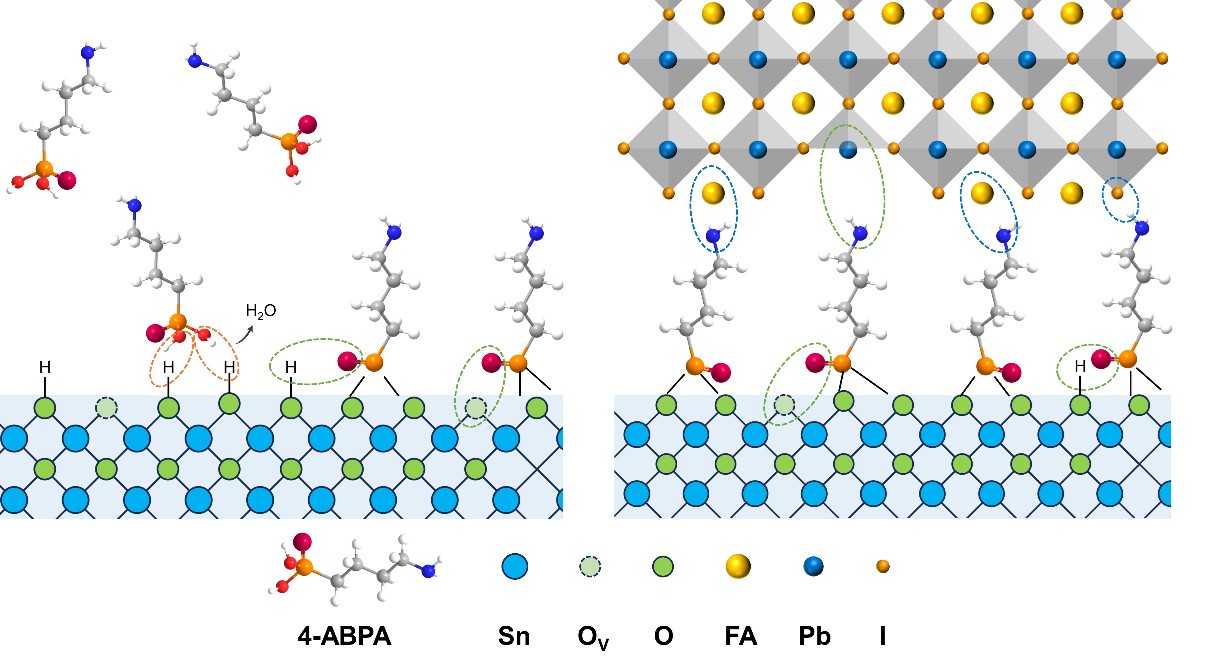
近日,中国科学院大连化学物理研究所的太阳能研究部薄膜硅太阳电池研究组(DNL1606组)杨栋研究员团队联合湖北大学吴聪聪教授团队在钙钛矿太阳能电池研究领域取得新进展,提出了一种通过分子桥接策略调控埋底界面,以实现高效缺陷钝化和能级对齐的新方法。 Recently, the research group of Professor Yang Dong from the Solar Energy Research Department of Dalian Institute of Chemical Physics, Chinese Academy of Sciences, in collaboration with Professor Wu Congcong from Hubei University, has made new progress in the field of perovskite solar cells. They proposed a new method to control the bottom interface through a molecular bridging strategy, in order to achieve efficient defect passivation and energy level alignment. 钙钛矿材料因其优异的光电性能,被认为是下一代太阳能电池的有力竞争者之一。当前,钙钛矿多晶薄膜在埋底界面处不可避免地产生缺陷聚集、晶格失配和能级错配等问题,加剧非辐射复合,并加速光热降解,制约了钙钛矿太阳能电池实现高效率和长期稳定性。 Perovskite materials are regarded as one of the strong contenders for the next generation of solar cells due to their excellent photoelectric properties. Currently, perovskite polycrystalline films inevitably suffer from problems such as defect aggregation, lattice mismatch and energy level mismatch at the bottom interface, which intensify non-radiative recombination and accelerate photothermal degradation, thereby restricting the realization of high efficiency and long-term stability of perovskite solar cells.
针对上述问题,在本工作中,研究团队提出在电子传输层与钙钛矿层之间引入多功能分子桥接层,通过双位点化学键合实现界面性能的协同优化。团队将4-氨基丁基膦酸(4-ABPA)引入氧化锡(SnO2)电子传输层表面,利用其膦酸基团与SnO2形成稳定的P-O-Sn共价键,同时通过氨基与钙钛矿晶格中的Pb2+和I-发生静电相互作用,构建了稳固的分子桥接结构。 In response to the aforementioned issues, in this study, the research team proposed to introduce a multifunctional molecular bridging layer between the electron transport layer and the perovskite layer. Through dual-site chemical bonding, they achieved the synergistic optimization of interface performance. The team introduced 4-aminobutylphosphonic acid (4-ABPA) onto the surface of the tin oxide (SnO2) electron transport layer. By utilizing its phosphonic group to form stable P-O-Sn covalent bonds with SnO2, and through the amine group to interact electrostatically with Pb2+ and I- in the perovskite lattice, a stable molecular bridging structure was constructed. 研究发现,该分子桥接层不仅作为异相成核位点动态调控钙钛矿结晶过程,促进晶体择优取向生长,还有效缓解界面残余应力,抑制了界面缺陷形成,并优化了电子传输层与钙钛矿层之间的能级对齐。进一步,团队通过精确调控埋底界面的化学相互作用和结晶动力学,改善了钙钛矿薄膜的结晶质量和界面电荷传输性能,将电压损失降低至31 mV。在此基础上制备的n-i-p结构钙钛矿太阳能电池效率达到25.56%,且几乎无迟滞效应。团队将此策略拓展至p-i-n结构,器件效率进一步提升至26.45%。 The research found that this molecular bridging layer not only dynamically regulates the crystallization process of perovskite through its heterogeneous nucleation site, promoting the preferential growth of crystals, but also effectively alleviates the residual stress at the interface, inhibits the formation of interface defects, and optimizes the energy level alignment between the electron transport layer and the perovskite layer. Furthermore, the team improved the crystallization quality and interface charge transport performance of the perovskite films by precisely controlling the chemical interactions at the bottom interface and the crystallization kinetics. The voltage loss was reduced to 31 mV. Based on this, the n-i-p structured perovskite solar cell achieved an efficiency of 25.56%, with almost no hysteresis effect. The team extended this strategy to the p-i-n structure, and the device efficiency was further improved to 26.45%. 此外,钙钛矿太阳能电池表现出优异的长期运行稳定性:在最大功率点跟踪1440小时后仍可保持初始效率的83.91%,在环境条件下储存2600小时后保持91.59%。该工作建立了系统的埋底界面工程策略,为通过分子设计实现高效稳定的钙钛矿太阳能电池提供了可推广的方法,有望推动钙钛矿太阳能电池的大规模生产。 Furthermore, perovskite solar cells exhibit excellent long-term operational stability: they can maintain the initial efficiency of 83.91% after tracking the maximum power point for 1440 hours, and retain 91.59% after being stored under environmental conditions for 2600 hours. This work has established a systematic bottom interface engineering strategy, providing a scalable method for achieving highly efficient and stable perovskite solar cells through molecular design, and is expected to promote the large-scale production of perovskite solar cells. 相关研究成果以“Molecular Bridge Regulation of Buried Interface in Perovskite Solar Cells”为题,于近日发表在《先进材料》(Advanced Materials)上。该工作的第一作者是研究所DNL1606组联合培养博士研究生周泽铸。上述工作得到国家自然科学基金、中国科学院B类先导专项“高效低成本大面积钙钛矿光伏电池研究”、湖北省重点研发计划等项目的资助。 The relevant research results, titled "Molecular Bridge Regulation of Buried Interface in Perovskite Solar Cells", were recently published in the journal "Advanced Materials". The first author of this work is Zhou Zeczhu, a joint doctoral student from the DNL1606 group of the institute. This research was supported by projects such as the National Natural Science Foundation of China, the B-class Leading Program of the Chinese Academy of Sciences "Research on High-Efficiency and Low-Cost Large-Area Perovskite Photovoltaic Cells", and the Key Research Program of Hubei Province. 文章链接:https://doi.org/10.1002/adma.202519267 |