霍尔木兹海峡及石油天然气市场的关键事实
欢迎阅读与学习    | 来源:iea   

免职声明:本网站为公益性网站,部分信息来自网络,如果涉及贵网站的知识产权,请及时反馈,我们承诺第一时间删除!

This website is a public welfare website, part of the information from the Internet, if it involves the intellectual property rights of your website, please timely feedback, we promise to delete the first time.

电话Tel: 13002979178 OR 邮箱Email: Lngbbs@qq.com

摘要:国际能源署正在密切关注中东局势,包括霍尔木兹海峡能源流动长期中断可能带来的影响。 冲突阻碍了霍尔木兹海峡的石油流通,迫使部分运营商开始停产。该地区的成品产品和液化天然气(LNG)产量也受到了重大影响。国际能源署将继续与全球各国政府协调评估该局势的能源安全影响。

分享到:

当前市场背景

自战争爆发以来,石油和天然气价格飙升。截至3月6日,布伦特原油期货上涨了27%,而荷兰TTF,作为欧洲天然气基准指数,上涨近70%。此外,一些石油产品市场受到了特别大的冲击,包括柴油和航空燃油市场。Oil and natural gas prices have spiked since the start of hostilities. Brent crude futures climbed by 27% through 6 March, and Dutch TTF, the European benchmark for natural gas, was up by nearly 70%. Moreover, some markets for oil products have been particularly affected, including those for diesel and jet fuel.

自2025年初以来,全球石油市场一直出现显著的顺差。在2月28日开始的军事行动之前,全球石油供应预计将在2026年远超需求。然而,长期的供应中断可能会使市场陷入逆差。

The global oil market has been in significant surplus since the start of 2025. Ahead of the military actions that began on 28 February, global oil supply was also expected to far exceed demand in 2026. However, prolonged supply disruptions could flip the market into a deficit.


2025年全球观察到的石油库存超过82亿桶,为自2021年以来的最高水平。这些股票现在为抵御供应中断提供了有利的缓冲。Global observed oil inventories rose to more than 8.2 billion barrels in 2025, their highest level since 2021. These stocks now provide a welcome cushion against supply disruptions.  

值得注意的是,IEA成员国持有超过12亿桶公共应急石油库存。这些以及另外6亿份政府债务持有的工业股票,可以在需要时为市场带来额外供应。Notably, IEA Member countries hold over 1.2 billion barrels of public emergency oil stocks. These, and a further 600 million of industry stocks held under government obligation, can bring additional supply to market if needed.

自2022年2月俄罗斯入侵乌克兰引发重大冲击后,天然气市场已逐步实现平衡。预计在本十年末前,一波新的液化天然气产能将改变市场格局。但2026年前两个月市场依然紧张,北半球供暖季结束后储能耗尽,预计未来几个月对LNG的需求将增加。Natural gas markets have gradually rebalanced following the major shock that followed Russia’s invasion of Ukraine in February 2022. A wave of new LNG capacity between now and the end of this decade is expected to transform market dynamics. But markets remained tight in the first two months of 2026, and depleted storage coming out of the heating season in the Northern Hemisphere is set to increase the call on LNG in the months ahead.

卡塔尔拉斯拉凡工厂的长期产能损失可能会显著加剧市场紧张。3月2日,工厂遭袭后,生产被迫停产。2025年,拉斯拉凡生产了1120亿立方米LNG,以及每天30万桶液化石油气(LPG)和18万桶凝析油,成为世界上最大的LNG设施,远远领先。An extended loss of output from the Ras Laffan facility in Qatar could significantly exacerbate this market tightness. Production was shut down following an attack on the facilities on 2 March. In 2025, Ras Laffan produced 112 billion cubic metres (bcm) of LNG, as well as 300 000 barrels per day of liquefied petroleum gas (LPG) and 180 000 barrels per day of condensate, making it the largest LNG facility in the world by some distance.

海湾地区是石油产品出口到全球市场的重要来源,尤其是柴油和喷气燃料等中间馏分产品。全球范围内,中馏分市场相较于其他产品相对紧张,持续进口欧洲市场是主要驱动力。因此,炼油厂似乎几乎没有灵活性进一步提高柴油和喷气燃料的产出率以应对持续供应损失。The Gulf region is a key source of exports of oil products to global markets, notably for middle distillates such as diesel and jet fuel. Globally, markets for middle distillates have been relatively tight compared with those for other products, with sustained imports into European markets a key driver. As such, there appears to be little flexibility for refineries to increase the yield of diesel and jet fuel further to compensate in the event of sustained supply losses.


霍尔木兹海峡:关键事实Strait of Hormuz: Key facts

霍尔木兹海峡是一条狭窄的海峡,分隔阿拉伯半岛和伊朗,连接波斯湾与阿曼湾及阿拉伯海。作为重要的贸易动脉,它是沙特阿拉伯、阿拉伯联合酋长国(UAE)、科威特、卡塔尔、伊拉克、巴林和伊朗生产石油和天然气的主要出口路线。The Strait of Hormuz is a narrow sea passage, separating the Arabian Peninsula and Iran, and connecting the Persian Gulf with the Gulf of Oman and the Arabian Sea. A crucial trade artery, it is the primary export route for oil and natural gas produced by Saudi Arabia, the United Arab Emirates (UAE), Kuwait, Qatar, Iraq, Bahrain and Iran.

在2025年,霍尔木兹海峡平均每天有2000万桶原油及石油产品通过,约占全球海上石油贸易的25%。如果海峡航运长时间中断,石油和液化天然气市场将面临重大供应中断。An average of 20 million barrels per day (mb/d) of crude oil and oil products transited the Strait of Hormuz in 2025, or around 25% of the world’s seaborne oil trade. Oil and LNG markets would face significant supply disruptions if shipping through the Strait is interrupted for an extended period.

绕过霍尔木兹海峡的油流选择有限。只有沙特阿拉伯和阿联酋拥有可绕过海峡的原油管道,预计可用容量为350万吨至550万桶/天。包括伊朗、伊拉克、科威特、卡塔尔和巴林在内的其他国家,也非常依赖海峡输送绝大部分石油出口。Options for oil flows to bypass the Strait of Hormuz are limited. Only Saudi Arabia and the UAE have operational crude pipelines that could potentially reroute flows to bypass the Strait, with an estimated 3.5 mb/d to 5.5 mb/d of available capacity. Other countries, including Iran, Iraq, Kuwait, Qatar and Bahrain, rely on the Strait to deliver the vast majority of their oil exports.


2025年通过霍尔木兹海峡的原油出口

Crude oil exports transiting the strait of Hormuz by destination, 2025

crude oil exports

2025年通过霍尔木兹海峡的石油产品

Oil products transiting the strait of Hormuz by destination, 2025oil exports
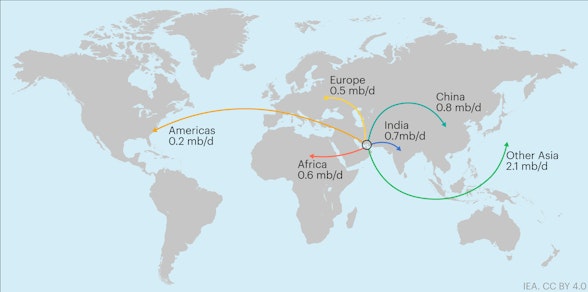

2025年,约80%的石油及石油产品通过海峡运往亚洲。然而,长期航运中断的影响将是全球性的,因为价格受到影响,且可能出现实物短缺。霍尔木兹海峡的任何长时间中断也可能使全球绝大多数备用石油产能无法使用,而这些产能大多由沙特阿拉伯持有。About 80% of oil and oil products transiting the Strait in 2025 was destined for Asia. However, the impacts of a prolonged disruption to shipping would be global given the impact on prices and potential for physical shortages to develop. Any extended disruption in the Strait of Hormuz could also render unavailable the vast majority of the world’s spare oil production capacity, most of which is held by Saudi Arabia.


此外,2025年有超过1100亿立方米(bcm)LNG通过霍尔木兹海峡。约93%的卡塔尔和96%的阿联酋液化天然气出口通过海峡,占全球液化天然气贸易近五分之一。没有其他途径可以将这些销量推向市场。In addition, over 110 billion cubic metres (bcm) of LNG passed through the Strait of Hormuz in 2025. About 93% of Qatar’s and 96% of the UAE’s LNG exports transited through the Strait, representing almost one-fifth of global LNG trade. There are no alternative routes to bring these volumes to market.


卡塔尔和阿联酋的大部分液化天然气销往亚洲。2025年,通过霍尔木兹海峡出口的总量中,近90%的出口量销往亚洲市场。略高于10%的出口销往欧洲。然而,与石油一样,长期中断将带来全球性影响。与阿联酋或卡塔尔签有长期合同的国家需要转向LNG现货市场。这反过来将推高全球天然气价格。Most LNG from Qatar and the UAE goes to Asia. In 2025, almost 90% of the total volumes exported via the Strait of Hormuz was destined for the Asian market. Just over 10% went to Europe. Yet, as with oil, extended disruptions would have global consequences. Countries that have long-term contracts with the UAE or Qatar would need to turn to the spot market for LNG. This, in turn, would drive up natural gas prices around the world.


】【打印繁体】【投稿】 【收藏】 【推荐】 【举报】 【评论】 【关闭】【返回顶部